 |
|
|
|
|
|
|
 |
 |
 |
 |
 |
 |
|
 |
 |
 |
|
|||
 |
 |
 |
|
|||
 |
 |
 |
|

| Force
Elementary reported their playground conflict managers either
mediated or prevented, by being present, 114 conflicts on the
playground. I feel the program was of great benefit to our
students. Ken Hanson, AP, Force Elementary |
by
teaching Conflict Management
You Can Have . . .
- more time to teach academics
- solid alternatives to suspension
- fewer discipline referrals to the office
- measurable results with behavioral change
- conflict and anger management skill building
- more cooperation with parents
- peace in your school and community
|
|
|
 |
 |
|
 |
|
|
 |
|
|
 |
|
|
 |
|
|
 |
|
|
 |
|
|
 |
|
|
 |
|
|
 |
|
|
 |
|
|
 |
|
|
 |
|
|
 |
|

School Programs
The Conflict Center Approach
School Program Components
Proven Results
Curriculum
Best Practices
The Conflict Center works with you to meet your school’s needs.
| When we asked for specific topics to be covered, you responded
with appropriate subject matter in a professional way. This enabled
us to work with you in providing a program tailored to the needs
of our building. Our paraprofessionals were particularly impressed
with the training classes you provided and have expressed interest
in continuing during the next school year. Mary Starker, counselor, Lansing Elementary |
Full school program:
The proven, most effective approach is a three-stage, or three-year process.
Each stage has a different emphasis as TCC helps a school move towards
a model that will sustain itself, regardless of changes in students or
staff. Every level of the school is involved, including administration,
teachers, support staff, students and parents. Each stage involves numerous
assessments, both statistical and anecdotal, in order to determine the
effectiveness of the programming. This program is designed for elementary
and/or K-8 schools.

- Coaching and Leadership training
- Adult interpersonal conflict management
- Classroom management
- Playground conflict management
- Curriculum development
- Parent education
- Paraprofessional training
- Classroom demonstration lessons
- Applied
alternative dispute resolution
- Facilitation
- Mediation
- Negotiation
- Reading for Peace
- And much more . . .
In addition we offer faculty in-services and other contract services. Each of our modules can be used to build a program specifically oriented to the needs of your group. A portion of the first workshop will incorporate some basic conflict management work that looks at ways teachers, students or parents can choose productive behavior in any conflict situation.
| In
many cases the students learned about positive responses to conflict
that are totally foreign to what they experience in their homes. Brad Brauer, Prevention Coordinator, East Middle School |
- Published elementary and middle school curriculum, (Peacemaking made Practical in English and Spanish and The Conflict Center’s Secondary School Curriculum)
- Powerful Me!, a CD-ROM computer game for elementary age children to teach and reinforce skills for non-violence
- 159 schools have used The Conflict Center’s programs in the past eight years. Over 53,500 students, 7,900 faculty and staff, and hundreds of parents have been trained with the lifetime skills of peacemaking
- Undergraduate, graduate and professional internships available. The Conflict Center staff has trained over 40 interns in programs individually designed to meet a variety of disciplines interested in conflict management.
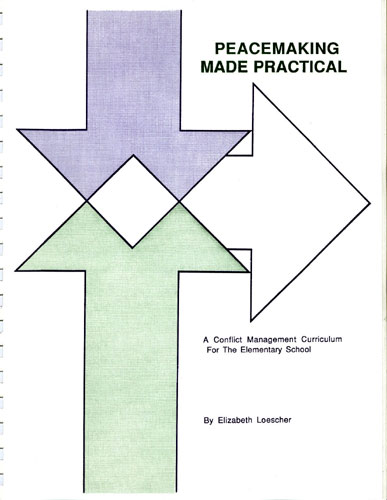
The Conflict Center traces its origins back to an elementary school curriculum entitled "Peacemaking Made Practical" that was developed by the Center's founder, Elizabeth Loescher, 15 years ago.
As a classroom teacher, Ms. Loescher found a significant portion of her time was being spend "refereeing" her students' disagreements & conflicts. Because the time spent as a "referee" detracted from her time as an educator, she decided to develop a curriculum that teaches young people the skills they need to manage many of their own conflicts in the classroom or on the playground.
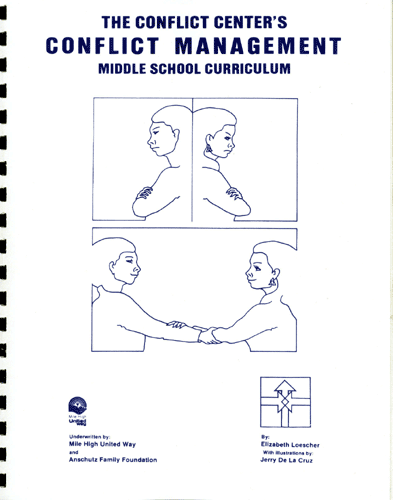
Curriculum are also available for Middle School and High School age students.
The skills taught by The Conflict Center's curriculum have been demonstrated to be effective based on empirical data such as a "reduction in office referrals," and "fewer playground fights" as recorded by school staff.
Since the creation of Peacemaking Made Practical, similar curriculum have been developed by other organizations and evaluated to also be effective in reducing levels of violence in the school. Several of these school-based programs have been evaluated with science-based research and are now considered to be "Exemplary" or "Model" Programs for reducing youth violence.
There is no question that youth in grades K-12 can learn conflict management/violence prevention concepts and skills. These social-cognitive skills not only help students identify alternatives to violence but they also help students build better relationships and become better problem solvers.
In addition to reducing the levels of violence in the school, The Conflict Center's curriculum takes a positive approach and provides skills for managing conflict constructively.
The Conflict Center, in its commitment to provide quality services and products, has adopted the principles outlined in the U.S. Department of Health, "Best Practices." Our staff can help you and your school apply "Best Practices" to your specific needs to assure your intervention/prevention program will be effective. We can help you in defining specific "learning objectives" as they pertain to violence reduction, bully proofing, anger management, and conflict management. We can then assist you in selecting the most cost effective, evidence-based program for your particular needs.
The Conflict Center understands that an effective Violence Prevention / Peacemaking intervention program for your school requires more than a curriculum. To be effective, the intervention program must address the unique needs of your students, consider the educational goals of your school's staff and local administration, respect the views of your community, and comply with State and Federal guidelines.
For
more information, please contact Jorge.Gibbons@conflictcenter.org
Phone: 303 433-4983 Fax: 303 433-6166
E-mail: schools@conflictcenter.org
| ©
2008 The Conflict Center Report Technical Problems |
[Home] [About Us] [Contact Us] [Search our Site] |
 |